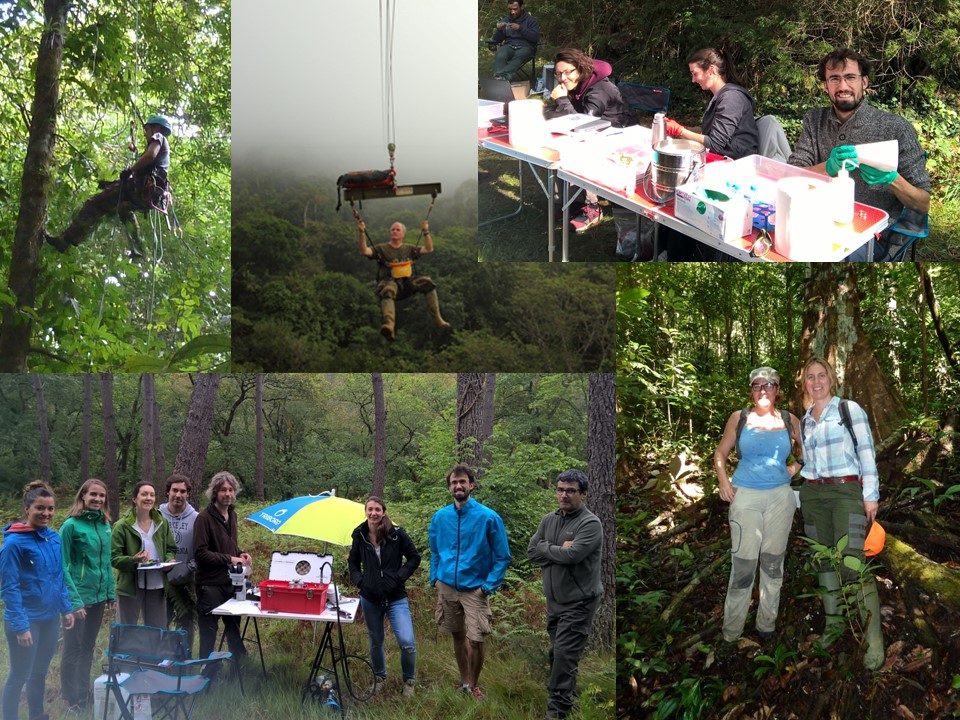
Plants are associated with diverse communities of micro-organisms (bacteria, fungi, oomycetes…) that collectively form the microbiome. These micro-organisms, which can be beneficial or cause diseases, colonize all plant organs (roots, stems, leaves, fruits…). We specifically study the microbial habitat formed by the surface of plant leaves (the phyllosphere). Like the root surface, the leaf surface harbor hyperdiverse microbial communities. We study the influence of these communities on plant performance and ecosystem functions in temperate forests, tropical forests and agricultural ecosystems (e.g. vineyards). We analyze the complex interactions between plants, microbes and their environment. Applications include biocontrol of plant diseases and biomonitoring of ecosystem health.
Read more:
- Fournier P. (*), Pellan L. (*), Barroso-Bergadà D., Bohan D. A., Candresse T., Delmotte F., Dufour M.-C., Lauvergeat V., Le Marrec C., Marais A., Martins G., Masneuf-Pomarède I., Rey P., Sherman D., This P., Frioux C., Labarthe S., Vacher C. 2022. The functional microbiome of grapevine throughout plant evolutionary history and lifetime. Advances in Ecological Research, 67: 27-99. (*) co-first authors (doi: 10.1016/bs.aecr.2022.09.001)
- Compant S., Cambon M., Vacher C., Mitter B., Samad A., Sessitch A. 2021. The plant endosphere world – bacterial life within plants. Environmental Microbiology, 23(4): 1812–1829 (doi: 10.1111/1462-2920.15240)
- Vacher, C., Hampe, A., Porté, A.J., Sauer, U., Compant, S., Morris, C.E. 2016. The phyllosphere: microbial jungle at the plant-climate interface. Annual Review of Ecology, Evolution, and Systematics, vol. 47, 1-24 (doi: 10.1146/annurev-ecolsys-121415-032238)
 Corinne VACHER, PhD